ORSA Stress Testing and Scenario Analysis for Singapore Insurers: What MAS Expects
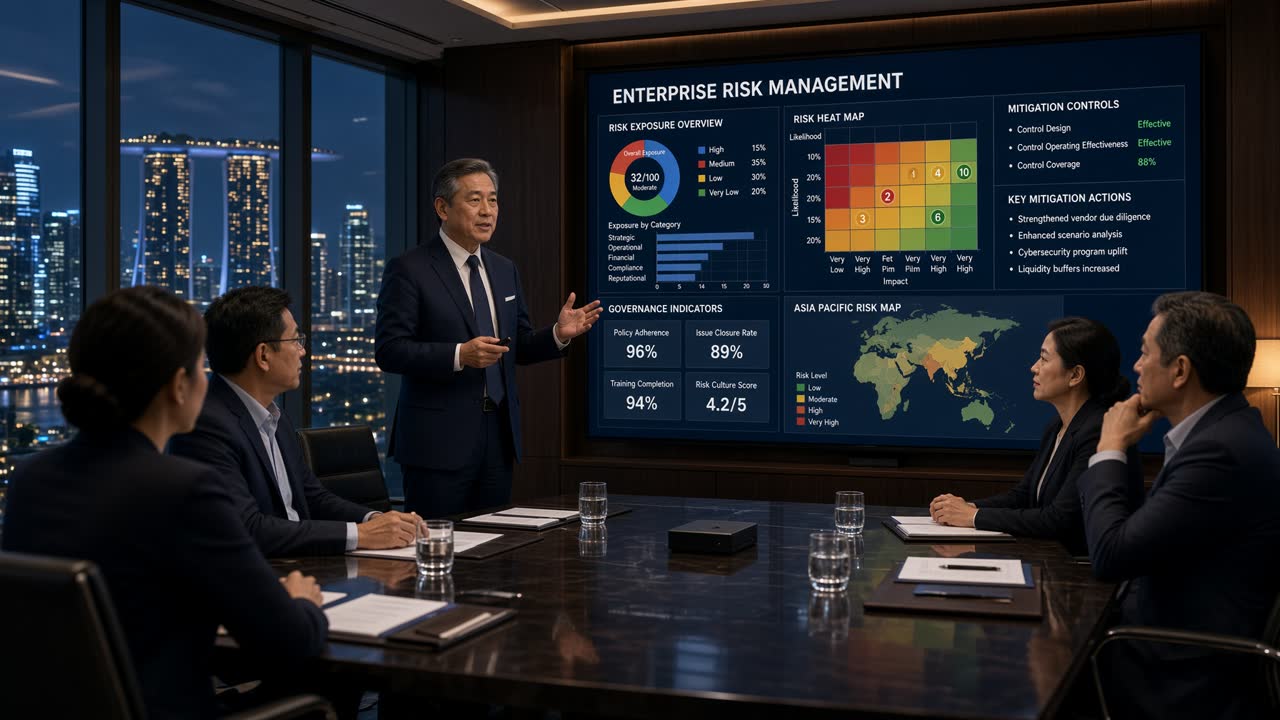
How to design ORSA stress testing, scenario analysis and reverse stress tests that meet MAS expectations under Notice 126 and RBC2. Covers scenario design from the insurer's own risk profile, non-financial risk, management actions and board governance.
ORSA stress testing in a Singapore insurer must do more than re-run the RBC2 standard formula with a few shocked inputs. MAS expects the stress and scenario analysis in the ORSA to be forward-looking, tied to the insurer's own risk profile and business plan, and used by the board to test whether capital remains adequate and whether risk appetite limits hold. The stress tests that draw supervisory challenge are typically generic, backward-looking, silent on non-financial risk, or disconnected from management actions. This article sets out how to design ORSA stress testing, scenario analysis and reverse stress testing that stand up to review.
What MAS expects from ORSA stress testing
The ORSA requirement for licensed insurers sits within the enterprise risk management expectations in MAS Notice 126, and the ORSA is completed at least annually and after material changes to the risk profile, strategy or solvency position. Within it, MAS expects the insurer to project its solvency position over the business planning horizon under a base case and under adverse scenarios, and to show that it can continue to meet its capital requirements, including the Prescribed Capital Requirement and the Minimum Capital Requirement under RBC2, throughout that period.
Three expectations recur in supervisory feedback. First, the stress tests must reflect the insurer's own material risks, not only the risks that the regulatory capital formula captures. Second, the ORSA must show the outcome of each test in terms of capital, liquidity and risk appetite, not only a headline solvency ratio. Third, the board must be demonstrably engaged: it should approve the scenarios, challenge the results and own the resulting actions. A stress testing section that is prepared by the actuarial function and merely noted by the board is a common finding.
If your ORSA process needs an independent view, an ORSA advisory review can test the stress testing programme against these expectations before the next submission.
Sensitivity analysis, scenario analysis and reverse stress testing
The three techniques answer different questions, and an ORSA should use all of them deliberately.
Sensitivity analysis moves one risk factor at a time, for example a 100 basis point fall in the risk-free yield curve, a 20 percent fall in equity markets, or a 10 percent increase in lapse rates. It is useful for understanding the capital impact of individual drivers and for validating the model, but it says little about how risks interact.
Scenario analysis moves several risk factors together through a coherent narrative, such as a prolonged low-rate environment combined with credit spread widening and rising lapses, or a severe pandemic combined with an equity fall. The value of a scenario lies in its internal consistency: the economic story must explain why each variable moves and in which direction, and the insurer must trace the effect through assets, liabilities, reinsurance and expenses.
Reverse stress testing starts from an outcome, typically breach of the PCR or MCR, loss of financial viability, or a breach of a risk appetite limit, and works backwards to identify the combinations of events that would cause it. It is the technique that most directly tests whether the insurer understands the limits of its business model. The point is not to estimate a probability but to expose vulnerabilities that forward scenarios miss, and to decide which of them warrant earlier warning indicators or changes to strategy.
Designing scenarios from the insurer's own risk profile
A scenario set that could be copied from another insurer is a sign that it was not designed from the insurer's own risk register. A practical design process runs as follows.
Start with the risk profile. Identify the five to ten risks that contribute most to capital consumption or that threaten the business plan, including those that RBC2 does not fully capture, such as concentration risk, liquidity risk, reputational risk, group risk and operational resilience. Map each to a plausible severe event.
Calibrate severity with reference points. The RBC2 framework calibrates the PCR to a 99.5 percent confidence level over a one-year horizon, so ORSA scenarios should be severe enough to be meaningful against that benchmark and, where the insurer's profile differs from the standard formula, should show why the insurer's own view of capital need is higher or lower. Document the basis for each severity: historical data, expert judgement, regulator-prescribed shocks or external scenarios.
Cover the full planning horizon. A single-year shock does not test a multi-year business plan. Scenarios should be run across the projection period, with the timing of the shock varied where it matters, for example a shock in year one versus year three when new business strategy and capital raising plans differ.
Include scenarios specific to the insurer's model. A life insurer with a large participating fund needs scenarios on bonus and guarantee costs. A general insurer with property catastrophe exposure needs aggregate and reinsurance recoverability scenarios. A captive or a reinsurer with a concentrated cedant base needs a counterparty or parent default scenario. Our guide on MAS Notice 126 and enterprise risk management explains how these risks fit into the wider framework.
Non-financial risk in ORSA scenarios
MAS has observed that insurers give limited consideration to non-financial risk in the ORSA, and that is where stress testing most often falls short. Operational, technology, cyber, conduct and outsourcing risks can produce losses, remediation costs, business interruption and reputational damage that are large relative to capital, yet the standard formula does not model them in the same way as market or insurance risk.
A credible approach is to build at least two or three non-financial scenarios into the programme. Examples include a prolonged outage at a critical outsourced service provider, a cyber incident that compromises policyholder data and interrupts claims processing, and a conduct failure in a distribution channel that requires redress and halts new sales. For each, quantify the financial effect where possible, using internal loss data, scenario workshops with business owners and external loss benchmarks, and where quantification is not credible, describe the qualitative impact and the resulting limit or control response.
The scenarios should link to the insurer's technology risk and resilience work. Our article on technology risk management for insurers in Singapore covers the control environment these scenarios should test.
Management actions, liquidity and capital planning
A stress test result is only half of the analysis. MAS expects the ORSA to show what management would do if a scenario crystallised, and whether those actions are credible within the time available.
Management actions must be specific and realistic. Typical actions include reducing dividends, cutting new business, repricing, changing the investment allocation, increasing reinsurance cession, raising capital from the parent or market, and restructuring. For each, the ORSA should state who has authority, how long it would take, what it would cost and what the capital benefit would be. Actions that depend on a parent injecting capital need evidence that the parent has both the capacity and the willingness to provide support, which links directly to the group risk issues discussed in our article on ORSA group risk assessment.
Liquidity deserves separate treatment. A scenario that leaves the insurer solvent on paper but unable to meet collateral calls, surrender requests or claims payments in the short term is a failure of the stress test design, not a pass. Include liquidity metrics alongside solvency metrics in each scenario output.
Finally, link the results to the risk appetite statement. Each scenario should show which risk appetite limits are breached, at what point early warning triggers fire, and what escalation follows. Where the results show that the insurer would breach its limits under plausible scenarios, the ORSA should either recalibrate the limits with a rationale or record the planned remediation.
Governance, documentation and common review findings
The mechanics of governance affect how a supervisor reads the ORSA. The board should approve the stress testing methodology and scenario selection, receive the results with commentary from the chief risk officer and the appointed actuary where relevant, and record its challenge and decisions in the minutes. The ORSA report should explain the assumptions, limitations and data quality issues behind each test, and should state when the programme was last independently reviewed.
Findings that recur in practice include scenarios that are unchanged year after year, results reported without capital and liquidity detail, reverse stress tests that restate the PCR breach without identifying causes, non-financial risks that appear in the risk register but not in the stress tests, and management actions listed without ownership or timing. Each is correctable through a structured annual refresh: revisit the risk register, update scenario narratives for current conditions, rerun the programme on the latest plan and record the board's response.
A useful test before submission is to ask whether a board member, reading only the stress testing section, could explain what would break the insurer, how soon the insurer would know, and what the board would do. If the answer is no, the section needs more work.
Next steps
If your ORSA stress testing programme has not been independently reviewed, or you want to strengthen scenario design, reverse stress testing and non-financial risk coverage before the next MAS submission, speak to our team about ORSA advisory support, and review the related enterprise risk management services for the wider framework.
Questions about how this applies to your organisation? Our consultants are available to discuss your specific position.
More in Risk
Briefing details
- Category
- Risk
- Reading time
- 8 min read
- Published
- 25 November 2026