MAS Notice 126 Enterprise Risk Management for Insurers: A Practical Compliance Guide
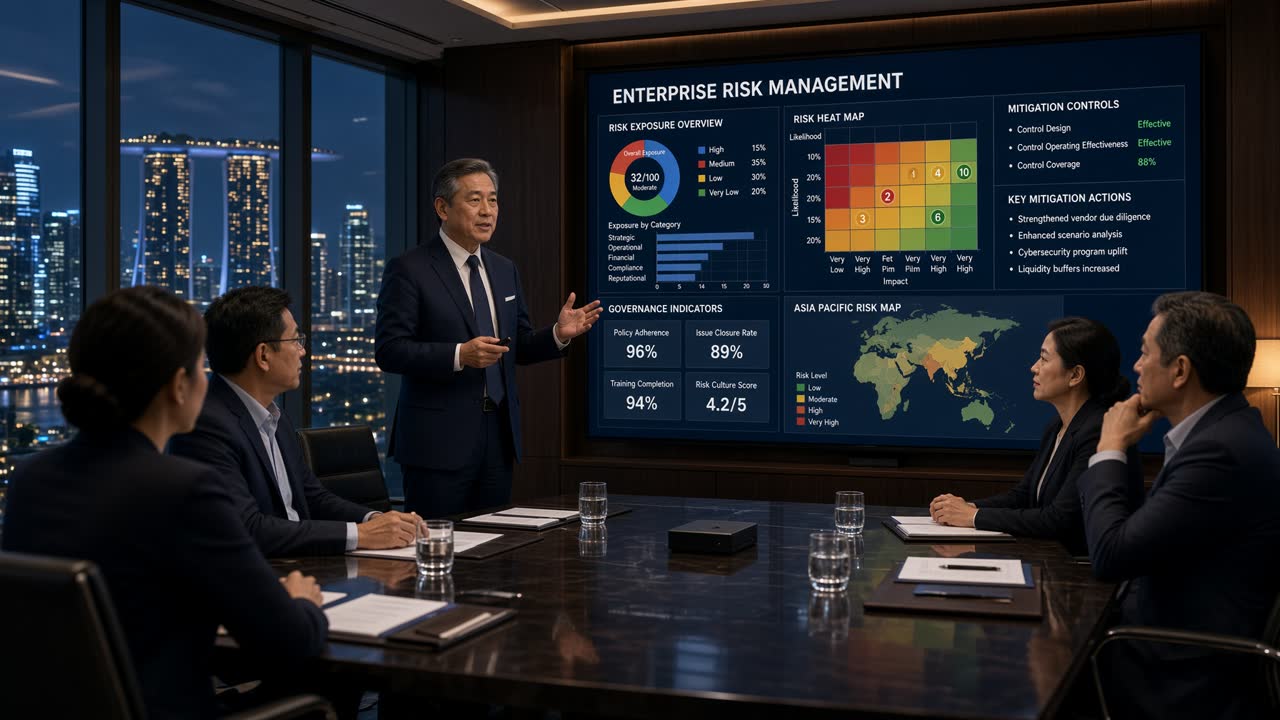
A practical walk-through of MAS Notice 126 and the FHC-N126 group extension, separating mandatory requirements from supporting guidance. Covers ORSA expectations, what MAS looks for in an ERM framework and a gap assessment checklist for compliance and risk teams.
MAS Notice 126 enterprise risk management for insurers sets the binding minimum for how a Singapore-licensed insurer governs, identifies, measures, monitors and reports risk. In practical terms, a licensed insurer must maintain a board-approved ERM framework, run an Own Risk and Solvency Assessment (ORSA) on a defined cycle, and be able to show MAS that risk decisions are made inside that framework rather than alongside it. This guide walks through what the Notice requires, where the mandatory obligations sit, and how to test your own framework against them.
What Notice 126 Is and Who It Covers
Notice 126 is issued under the Insurance Act 1966 and applies to licensed insurers. Its group counterpart, Notice FHC-N126, extends equivalent obligations to financial holding companies, so that risk management is assessed at the level of the group as well as the licensed entity. FHC-N126 was amended in April 2024, and groups with a designated financial holding company should confirm which version their governance documents reference.
Scope matters, and it is the first thing to settle. Direct insurers and reinsurers licensed in Singapore are within the perimeter. Captive insurers and marine mutual insurers are treated differently, with exclusions or tailored treatment reflecting their narrower risk profile. Do not assume an exclusion applies to your entity from memory or from a prior year's checklist. Read the current text of the Notice, confirm your licence class, and record the scoping conclusion in your compliance register so the basis is documented when MAS asks.
Notice 126 sits alongside, not in place of, other instruments. Capital and valuation requirements sit in the RBC2 notices, outsourcing and technology risk in their own notices and guidelines, and anti-money laundering obligations in Notice 314. Notice 126 is the connective layer: it requires that those risks be captured within one enterprise framework. For a broader view of how the capital regime fits together, see our briefing on the RBC2 capital framework.
Mandatory Requirements Versus Supporting Guidance
A recurring mistake is treating the whole body of MAS risk management material as optional best practice. The Notice contains requirements that use mandatory language, and breach of those requirements is a regulatory breach, not a documentation weakness. Separate the two categories explicitly in your own policy library.
The mandatory core typically covers:
- A board-approved ERM framework proportionate to the nature, scale and complexity of the insurer's business.
- A risk appetite statement and risk limits approved by the board and cascaded into business decision-making.
- A defined risk governance structure, including board oversight and a risk management function with sufficient independence and resources.
- An ORSA, with its output considered in business planning and capital management.
- Policies for risk identification, assessment, monitoring and reporting across all material risk categories.
Supporting guidance, by contrast, describes how MAS expects a well-run framework to look: how to calibrate stress scenarios, how to integrate the ORSA with strategic planning, and how to evidence challenge by the board. Guidance is not a safe harbour to ignore. Inspection findings frequently cite weaknesses that sit in guidance territory but undermine a mandatory requirement, for example a risk appetite statement that exists on paper but does not constrain any business decision.
The Insurer ERM Framework MAS Expects to See
An insurer ERM framework in Singapore is assessed on whether it works, not on whether the documents exist. Reviewers look for five observable features.
First, ownership. The board approves the framework and the risk appetite, and minutes show real discussion of breaches, near-misses and trade-offs. A framework that the board has never amended or challenged is a warning sign.
Second, proportionality. A small reinsurer writing a narrow portfolio does not need the architecture of a regional composite, but it does need to be able to explain why its simpler approach is adequate for its risk profile.
Third, completeness of the risk taxonomy. Insurance, market, credit, liquidity, operational, strategic and group contagion risks should each have an owner, a measurement approach and a reporting line. Emerging risks, including climate and technology risk, should appear in the register with a stated treatment.
Fourth, integration. Risk limits must connect to pricing authority, reinsurance purchasing, investment mandates and capital planning. If the pricing committee never references the risk appetite statement, the framework is not integrated.
Fifth, independent assurance. The risk function reports to the board risk committee without dependence on the businesses it monitors, and internal audit or an external reviewer periodically tests the framework itself, not only individual controls.
ORSA Requirements for Singapore Insurers
The ORSA is the centrepiece of the Notice and the area where findings are most common. ORSA requirements Singapore insurers must meet include an assessment, at least annually and after any material change in risk profile, of overall solvency needs relative to the insurer's own risk profile, risk appetite and business plan, as well as continuous compliance with regulatory capital requirements.
In practice, MAS expects the following from an ORSA submission:
- A forward-looking projection of solvency over the business planning horizon, under base case and adverse scenarios, rather than a restatement of the current RBC2 position.
- Stress and reverse stress tests that reflect the insurer's actual concentrations, such as a dominant distribution partner, a catastrophe accumulation or a single reinsurer counterparty.
- A clear statement of the insurer's own view of capital needs, and an explanation of any difference from the regulatory requirement.
- Evidence that the board challenged the assumptions and that results fed into the business plan, capital actions or risk limits.
- A documented process, including data lineage, model governance and sign-off, so that the numbers can be reproduced.
MAS has publicly identified recurring weaknesses in ORSA practice, including late or incomplete submissions, scenarios that are not severe enough, and weak linkage between the ORSA and decisions. Our review of MAS Circular ID 01/26 on ORSA submission lapses sets out the specific lapses and how to avoid them. For groups, the assessment must also address group-level risks, which our briefing on group ORSA findings covers in detail.
The FHC-N126 Group Extension
For an insurance group headed by a financial holding company, Notice FHC-N126 requires the group to run an ERM framework and group ORSA covering the consolidated risk profile. The practical consequences are significant.
Group risk appetite must be set at the group level and translated into subsidiary limits that do not simply add up to the group figure. Intra-group exposures, guarantees, shared service dependencies and fungibility of capital across jurisdictions must be assessed explicitly. A subsidiary-level ORSA that is merely stapled together does not meet the intent.
Where the group includes entities outside Singapore, the group framework must reconcile local regulatory regimes with the Singapore approach. Differences in capital definitions, reserving bases and supervisory expectations should be mapped, with a documented position on how the group manages the gaps. Governance should also be clear on which board approves which document, since a holding company board and a licensed insurer board may both have approval responsibilities.
A Practical Gap Assessment Checklist
Before the next ORSA cycle or MAS engagement, test your framework against these questions. Each should have a documented answer and an owner.
- Is the scoping decision on Notice 126 and FHC-N126 recorded, with the licence class and any exclusion relied upon?
- Does the board approval date on the ERM framework and risk appetite statement fall within the review cycle set in your own policy?
- Can you show three decisions from the last twelve months that were changed or constrained by a risk limit?
- Do ORSA scenarios include at least one that threatens regulatory solvency, and what management actions follow?
- Is the ORSA submission timetable tied to the planning calendar, with buffers before any MAS deadline?
- Has an independent party reviewed the framework in the past two to three years, and were findings closed?
- For groups, is there a single group risk appetite with explicit subsidiary allocation and an intra-group exposure map?
If three or more answers are weak, the framework is likely to attract questions at inspection, and remediation is better done on your timetable than under a supervisory direction.
Common Findings and How to Avoid Them
Experience across Singapore insurers points to a handful of patterns. Risk appetite statements are set at a level that is never close to binding, so they never drive behaviour. Stress tests are calibrated to the last crisis rather than to the insurer's real vulnerabilities. ORSA reports are produced by the actuarial team in isolation, without business, finance and risk functions contributing to the narrative. Board minutes record approval but not challenge. Data and model governance for ORSA projections is informal, which means results cannot be reproduced when a regulator asks.
The remedies are procedural rather than technical: assign a named owner to each requirement of the Notice, calendar the annual cycle backwards from submission, require management actions to be recorded against each stress result, and have the board risk committee minute its challenge. None of these steps is costly, and together they convert a compliance document into a management tool.
Next Steps
If you are preparing for your next ORSA, reviewing your framework against Notice 126, or building a group framework under FHC-N126, our enterprise risk management and ORSA advisory teams can run an independent gap assessment and help you close findings before they reach MAS. Contact Alpha Consultant to scope a review.
Questions about how this applies to your organisation? Our consultants are available to discuss your specific position.
More in Risk
Briefing details
- Category
- Risk
- Reading time
- 8 min read
- Published
- 16 November 2026