ESG Risk Management for Asia Pacific Insurers: From Reporting to Integration
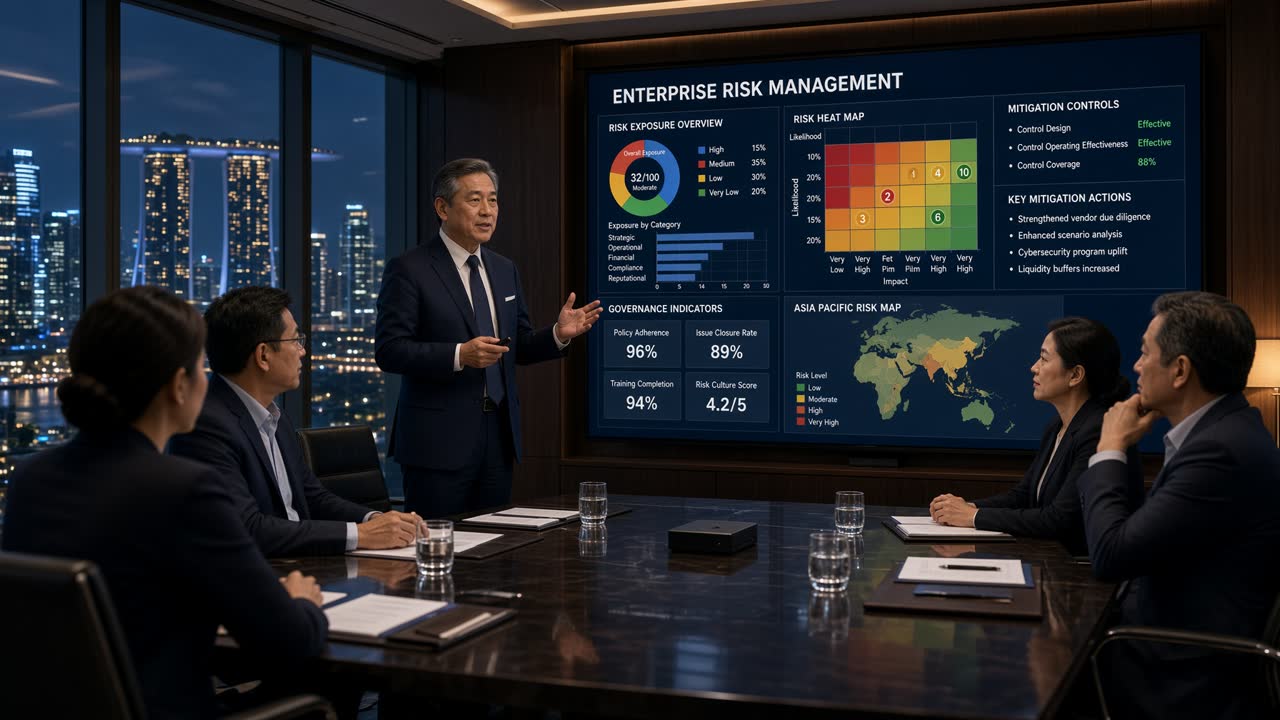
Regional regulators have made clear that climate and broader ESG risks should be integrated into insurers governance and risk frameworks, not treated as a sustainability reporting exercise. For most insurers in the region, the gap between regulatory expectation and current practice remains wide. This piece covers the key dimensions of ESG risk integration, from scenario analysis and transition risk assessment through to board-level governance and disclosure requirements.
The Regulatory Signal Is Clear
Across Asia Pacific, insurance regulators have moved from encouraging insurers to consider environmental, social and governance risks to expecting them to demonstrate that those risks are integrated into governance, risk management and capital frameworks. The trajectory is consistent whether you look at MAS in Singapore, the Hong Kong Insurance Authority, Bank Negara Malaysia or the regional guidance coming from IAIS.
For many insurers in the region, the honest assessment is that the gap between regulatory expectation and current practice remains wide. Sustainability reporting has advanced: more insurers publish sustainability reports aligned to TCFD or GRI frameworks, and board-level sustainability committees have proliferated. But genuine integration of climate and ESG risks into risk appetite frameworks, underwriting decision-making and investment governance is at an earlier stage.
This matters for two reasons beyond regulatory compliance. ESG risks, and climate risk in particular, have the potential to affect the financial position of insurers materially. They are not peripheral. They affect claims experience through physical risk, investment portfolio value through transition risk and reputational position through conduct and governance considerations. Second, the supervisory direction in Asia Pacific is toward more rigorous standards, not less. The gap between reporting and integration will narrow as a regulatory expectation more quickly than many insurers are currently moving.
What MAS Expects
MAS has been one of the more active regulators in Asia Pacific on climate and sustainability risk. Its expectations are set out through a combination of guidelines, supervisory expectations and the broader sustainable finance framework for Singapore.
MAS guidelines on environmental risk management, which apply to banks, insurers and asset managers, require financial institutions to have governance structures for environmental risk, to integrate environmental risk into risk management processes, and to develop the capability for scenario analysis and stress testing of environmental risk.
For insurers specifically, MAS expects:
- Board-level governance of climate and environmental risk, with clear ownership at senior management level
- Integration of environmental risk into existing risk management frameworks rather than treatment as a separate sustainability exercise
- Development of scenario analysis capability that covers both physical risk and transition risk
- Disclosure of material environmental risk information aligned to TCFD principles
- Engagement with the environmental risk profiles of significant reinsurance counterparties and investment portfolios
MAS has also been clear that it views the current state of disclosure and integration across the Singapore insurance sector as a starting point rather than an end state. The supervisory expectation is for continuous improvement in the depth and quality of environmental risk management.
Understanding the Risks: Physical and Transition
The ESG risk category is broad, but for most insurers in Asia Pacific, climate risk demands priority attention because its financial materiality is most direct and most near-term. Climate risk divides into two distinct categories with different drivers and timeframes.
Physical risk arises from the changing physical characteristics of the climate: more frequent and severe extreme weather events, rising sea levels, changing rainfall patterns and increasing average temperatures. For general insurers with property, marine and agricultural exposures, physical risk directly affects claims experience. The loss events from Typhoon Mangkhut, the Australian bushfires and major flooding events across Southeast Asia demonstrate that extreme weather losses are not tail risks in the probabilistic sense but recurring events whose frequency and severity are trending upward.
For life and health insurers, the physical risk dimension includes the health impacts of heat stress, air quality degradation and the spread of vector-borne diseases into previously unaffected regions.
Transition risk arises from the adjustment to a lower-carbon economy. Policy changes, technology shifts and changing investor and consumer preferences all affect the value of assets and the viability of business models across the economy. For insurers, transition risk is primarily an investment portfolio concern, but it also affects underwriting where insureds operate in sectors facing structural change.
The interaction between physical and transition risk is an important but often underappreciated dimension. A rapid transition to a low-carbon economy may reduce the long-term frequency of extreme weather events, but the near-term disruption it causes creates transition losses. A slow transition keeps transition losses manageable in the short term but means physical risk continues to accumulate.
Climate Risk in Underwriting
For general insurers and reinsurers, the integration of climate risk into underwriting is both a risk management imperative and an area of genuine analytical challenge.
Property and catastrophe underwriting is the most directly affected line. Climate science has advanced significantly in its ability to model how climate change is shifting the risk profile of specific perils and geographies, but the translation of that science into pricing and exposure management tools is still developing. Insurers that are writing significant property catastrophe exposure in the Asia Pacific region should be working with catastrophe model providers and climate scientists to understand how their models are evolving.
Flood and extreme weather modelling is particularly important in Southeast Asia, where flood events have caused substantial insured and uninsured losses. The insured proportion of total economic losses from weather events in Southeast Asia remains very low compared to developed markets, which represents an opportunity but also reflects the challenges of pricing flood risk in complex hydrological and social environments.
Underwriting guidelines and exclusions are an area where some insurers have moved more quickly than their risk management frameworks. Underwriting guidelines that restrict or exclude coverage for certain carbon-intensive industries have been introduced by some insurers, often in response to investor and reputational pressures rather than as a product of systematic risk assessment. The governance of underwriting guidelines that have sustainability dimensions should be as rigorous as those applied to conventional underwriting decisions.
Investment Portfolio Governance
For most insurers, the investment portfolio is the largest concentration of ESG and climate risk on the balance sheet. The exposure varies by portfolio composition, but for a life insurer with a significant bond and equity portfolio, the transition risk exposure to carbon-intensive sectors can be material.
Portfolio-level transition risk assessment requires analysis of the exposure to sectors and companies that face significant risk from the transition to a low-carbon economy. This includes fossil fuel extraction and related infrastructure, materials processing with high carbon intensity, and other sectors where transition risk is high. The analysis is not straightforward because transition risk operates over extended timeframes and the pathway of transition is uncertain.
Climate scenario analysis for investment portfolios has been developing rapidly. The Network for Greening the Financial System (NGFS) has developed climate scenarios that are widely used by central banks and regulators for system-level analysis, and insurers have been adapting these for portfolio-level application. MAS has incorporated NGFS scenarios into its supervisory expectations.
Stewardship and engagement is an increasingly important dimension of investment governance for insurers. Institutional investors, including insurance companies, are expected to use their position as shareholders to engage with investee companies on climate risk management and disclosure. The expectation from regulators, and increasingly from the insurers' own stakeholders, is that passive acceptance of poor climate risk management is not an appropriate posture for a significant institutional investor.
Board-Level Governance and Disclosure
The governance of ESG risk at board level is a recurring area of supervisory focus. The expectation is not simply that there is a board sustainability committee or that the board receives a sustainability report. It is that the board demonstrates genuine understanding of the material ESG risks facing the organisation and exercises substantive oversight of how those risks are managed.
What good board-level governance of ESG risk looks like:
The board receives regular, substantive reporting on material ESG risks, including climate risk, in a format that enables genuine oversight. This is different from a sustainability report that describes initiatives and commitments.
ESG risks are integrated into the risk appetite framework and the board risk committee receives reporting on ESG risk metrics alongside other risk categories.
The board has reviewed and approved the approach to climate scenario analysis and understands the results of that analysis in relation to the organisation's strategy.
ESG considerations are integrated into the board's review of major strategic decisions, including acquisitions, new product launches and significant investment decisions.
The board has oversight of the organisation's approach to climate-related disclosure and has reviewed the accuracy and completeness of disclosures before they are published.
TCFD-aligned disclosure has become the expected framework for climate risk reporting for financial institutions in Singapore and across the region. The four pillars of TCFD, governance, strategy, risk management, and metrics and targets, provide a useful structure for developing and presenting climate risk information. The quality of TCFD disclosures across the Asia Pacific insurance sector is improving but remains uneven.
Practical Steps Toward Genuine Integration
Moving from sustainability reporting to genuine risk integration is a multi-year journey that requires sustained commitment and investment in capability.
Step 1: Conduct a materiality assessment specific to your business. The ESG risks that matter most to your organisation depend on your product portfolio, your investment strategy and your geographic footprint. A general insurer with significant property exposure in typhoon-prone markets has a different priority set from a life insurer with a long-duration investment portfolio. Start with what is material, not what is most visible.
Step 2: Integrate climate risk into your existing risk framework. The most effective integration happens when climate risk is not treated as a separate category alongside existing risk categories but is incorporated into them. Physical risk belongs in your underwriting risk and property risk frameworks. Transition risk belongs in your investment risk and strategic risk frameworks. The ORSA is a natural home for climate scenario analysis.
Step 3: Build internal capability. Genuine ESG risk integration requires people who understand both the subject and the insurance business. External support is useful for specific analytical work, but the capability to monitor, assess and report on ESG risks should sit inside the organisation.
Step 4: Invest in data. ESG risk analysis is data-intensive, particularly for physical risk assessment and portfolio-level transition risk analysis. Understanding what data you have, what you need and how you will source it is a foundational step.
Step 5: Align disclosure with the internal picture. The most credible ESG disclosures are those that reflect what is actually happening inside the organisation. Where practice is still developing, honest disclosure of the current state and the improvement pathway is more credible than aspirational statements that are not grounded in the operational reality.
We work with insurers across Asia Pacific on climate risk integration, ORSA development that incorporates ESG scenarios, investment governance frameworks and board-level risk reporting. Our enterprise risk management practice covers the broader governance and risk framework into which climate risk integration should sit. If your organisation is working through an ESG risk integration programme or reviewing your approach to climate disclosure, our team is available to discuss your specific position.
Questions about how this applies to your organisation? Our consultants are available to discuss your specific position.
More in Risk & Governance
Briefing details
- Category
- Risk & Governance
- Reading time
- 9 min read
- Published
- 6 October 2026