Singapore vs Hong Kong Insurance Regulation: Capital, Licensing and Group Supervision Compared
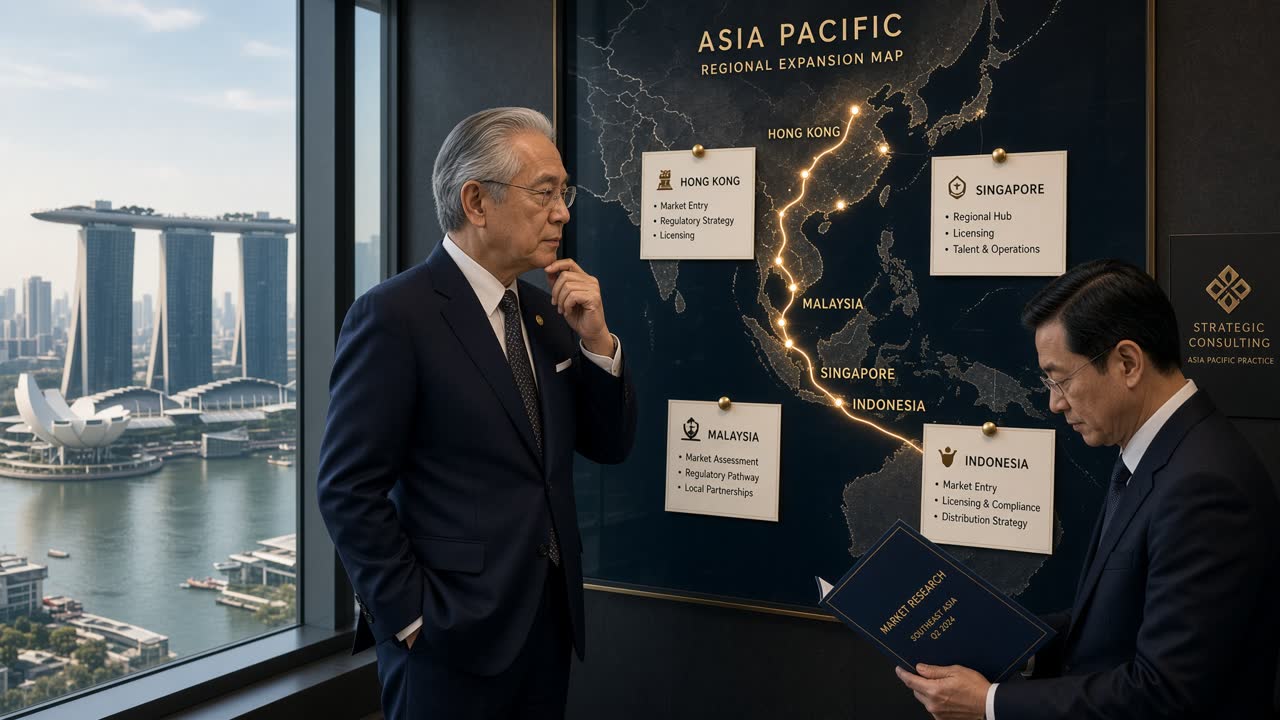
A side-by-side comparison of Singapore RBC2 and the Hong Kong RBC regime, licensing routes and group supervision for insurers choosing a regional hub. Sets out the factors to test and the steps to complete before committing capital.
Singapore and Hong Kong both offer a credible regional base for insurers, reinsurers and captives, and both now run economic, risk-based solvency regimes calibrated to a 99.5% one-year value at risk. The practical differences lie in the supervisory model, the licensing route, the treatment of group structures and the cost of running a regulated entity. This article compares Singapore vs Hong Kong insurance regulation on the points that most often decide a hub selection, and sets out what a compliance officer or CFO should test before committing capital.
Two Regulators, Two Supervisory Models
In Singapore, the Monetary Authority of Singapore (MAS) is an integrated regulator. It supervises banks, insurers, capital markets intermediaries and payment providers under one roof, and it is also the central bank. Insurers are regulated principally under the Insurance Act 1966, with detailed requirements in MAS Notices and Guidelines. For a financial group with bancassurance or asset management arms, a single supervisor can simplify engagement and reduce the risk of inconsistent expectations.
In Hong Kong, the Insurance Authority (IA) is a standalone, independent insurance regulator established under the Insurance Ordinance (Cap. 41). It took over from the former Office of the Commissioner of Insurance and, since 2019, has also directly licensed and supervised insurance intermediaries, replacing the earlier self-regulatory bodies. Banks are supervised separately by the Hong Kong Monetary Authority, and securities activities by the Securities and Futures Commission.
The consequence is a difference in supervisory dialogue. A Singapore insurer will often face a supervisory team that sees the whole financial group. A Hong Kong insurer deals with a specialist insurance authority, but a bancassurance group will still need to coordinate across more than one regulator.
Capital Regimes: Hong Kong RBC vs Singapore RBC2
Singapore moved to its second-generation risk-based capital framework, RBC2, which took effect on 31 March 2020. Hong Kong's risk-based capital regime came into force on 1 July 2024, after several years of consultation and quantitative impact studies. The headline architecture is similar, and that similarity is deliberate: both regulators drew on the Insurance Core Principles and the direction of travel set by the IAIS.
Common features include:
- Market-consistent valuation of assets and liabilities on a total balance sheet basis.
- A Prescribed Capital Requirement (PCR) calibrated to a 99.5% one-year value at risk.
- A Minimum Capital Requirement (MCR) acting as a hard floor below which the regulator's most severe intervention powers apply.
- A tiered classification of capital resources, with limits on the share of lower-quality instruments.
The detail diverges in ways that matter for a capital plan. Risk charges, diversification credits, discount curve construction, treatment of participating business and the calibration of credit and equity shocks all differ between the two regimes. An insurer with a long-duration life book, an Asian credit portfolio or a significant participating fund can see materially different capital ratios under the two sets of rules, even on identical economics. Anyone modelling a migration or a dual presence should run the same balance sheet through both calculations rather than assume the ratios are comparable. Our work on risk-based capital routinely starts with exactly this reconciliation.
Both regimes also require a forward-looking own risk and solvency assessment. In Singapore the ORSA is expected under MAS requirements on risk management for insurers; in Hong Kong, the Guideline on Enterprise Risk Management (GL21) and the associated ORSA requirement serve a similar purpose. For the ORSA, see our guidance on ORSA advisory.
Licensing Routes and Entity Types
Singapore authorises direct insurers, reinsurers and captive insurers as separate classes of registered insurer under the Insurance Act. Captive insurers sit on a lighter-touch track, and Singapore has actively positioned itself as a captive domicile, with tax incentives for qualifying captive business. Foreign reinsurers can in certain cases be authorised to accept Singapore business without establishing a local entity, which is a distinct route from full registration. A licensing application is made to MAS, which assesses the applicant's fitness and propriety, financial standing, business plan, risk management framework, actuarial arrangements and the credentials of its appointed executives, including the Appointed Actuary for life business.
Hong Kong authorises insurers under Cap. 41 as general business, long term business or composite insurers, and authorises captives and special purpose business such as insurance-linked securities vehicles under specific regimes. The IA applies its own authorisation criteria, which include minimum paid-up capital, a fit and proper test for controllers and directors, and requirements on the appointment of an Appointed Actuary for long term business and a Responsible Person for general business.
Practical points to compare during entity selection:
- Whether the intended business will be underwritten locally, written on a cross-border basis or ceded as reinsurance.
- The minimum capital and solvency margin that will apply to the proposed class.
- The approval timeline and the number of review rounds typically needed.
- Key person requirements and the local presence expected of the board and senior management.
Regulatory timelines are rarely fixed by statute. They depend on the completeness of the first submission, and weak applications lose months in clarification rounds. Our regulatory licensing practice treats the application pack as a document that must withstand supervisory challenge on every page.
Group Supervision and Holding Company Rules
Group structure is where the two jurisdictions increasingly diverge in practice. In Hong Kong, the IA has the power to designate an insurance holding company and apply group-wide supervision to the group of which it forms part. This approach was designed to make Hong Kong a suitable home supervisor for internationally active insurance groups, and it feeds directly into the IAIS framework for the supervision of such groups.
In Singapore, MAS supervises Singapore-incorporated insurers on a solo and, where relevant, a group basis, and it has powers over locally incorporated holding structures and over controllers of registered insurers. Changes in control of a Singapore-registered insurer require MAS approval under the Insurance Act, with thresholds set out in the Act. The Singapore position places particular emphasis on the identity, financial standing and track record of the shareholder controllers.
When a regional group is deciding where to place its holding company, the questions to answer are: which regulator will act as group-wide supervisor, what group capital measure applies, what intragroup transaction and exposure limits exist, and how the group's governance arrangements will be assessed. This analysis should also feed into the group's enterprise risk management framework, since the ERM framework must demonstrate to the supervisor that group-level risks are identified and managed.
Conduct, AML/CFT and Ongoing Compliance Burden
Both jurisdictions apply anti-money laundering and countering the financing of terrorism obligations to insurers, particularly in respect of life and investment-linked products, and both are members of the Financial Action Task Force with periodic mutual evaluations. In Singapore, the AML/CFT requirements for life insurers are set out in MAS Notice 314, with suspicious transaction reporting to the Suspicious Transaction Reporting Office. In Hong Kong, the Anti-Money Laundering and Counter-Terrorist Financing Ordinance (Cap. 615) and the IA's guideline on anti-money laundering apply, with reporting to the Joint Financial Intelligence Unit.
On technology and operational resilience, Singapore insurers work within the MAS Technology Risk Management Guidelines and the outsourcing requirements, while Hong Kong insurers follow IA guidance on cybersecurity and outsourcing. The detailed texts differ, but the supervisory questions are the same: governance of third parties, incident reporting, testing and board accountability.
The ongoing burden is not only a matter of rule counts. It is also the cost of the regulatory reporting cycle, the availability of qualified local actuaries and risk professionals, and the time a board must devote to oversight. These factors rarely appear in a comparison table but frequently drive the real operating cost.
How to Choose an Insurance Hub in Asia
There is no universally superior answer. A structured selection process usually weighs five factors:
- The target customer base and the distribution model, since cross-border access to mainland China, ASEAN or South Asia may favour one hub.
- Capital efficiency, tested by running the intended balance sheet through both RBC regimes.
- The supervisory fit for the group, including who will be the group-wide supervisor.
- Tax, treaty position and the availability of incentives for captives and reinsurers.
- Talent, including actuarial, risk and compliance resources, and the realistic cost of hiring them.
Many groups conclude that a presence in both places is justified, with a regional treasury, reinsurance or captive vehicle in one and a distribution or operating entity in the other. If so, the intragroup reinsurance arrangements need to be reviewed under both regimes, because a transaction that gives capital relief in one jurisdiction may be treated differently in the other.
What to Do Before Committing
Before filing in either jurisdiction, an insurer should settle the following:
- A written regulatory comparison of the proposed legal entity type under both regimes.
- A capital projection under RBC2 and Hong Kong RBC, using consistent economic assumptions.
- A mapping of group governance, including the board composition and key persons the regulator will expect.
- A pre-application dialogue plan with the relevant regulator, where the regulator invites one.
- An implementation timeline that allows for the regulator's questions and for post-approval conditions.
Insurers weighing Singapore as a hub, or looking to structure a regional group around it, can discuss the options with our team under market entry advisory, where we help clients assess the regulatory, capital and licensing path before a filing is made.
Questions about how this applies to your organisation? Our consultants are available to discuss your specific position.
More in APAC Markets
Briefing details
- Category
- APAC Markets
- Reading time
- 8 min read
- Published
- 27 November 2026