Entering Asia Pacific Insurance Markets: A Regulatory and Commercial Roadmap
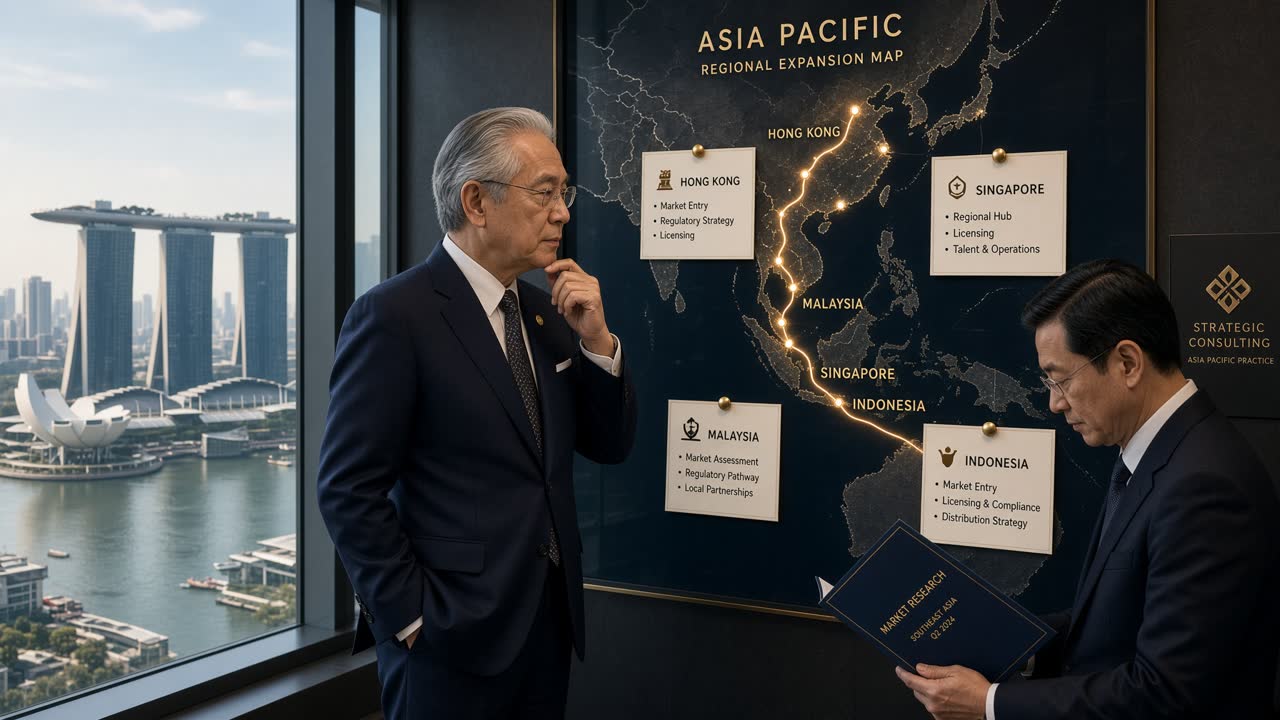
Expanding into Asia Pacific requires navigating nine distinct regulatory systems, each with its own foreign ownership rules, capital requirements, product approval timelines and distribution restrictions. Strategic decisions made at the design stage have long-term cost and operational consequences that are difficult to unwind. We set out the framework considerations for insurers and intermediaries assessing entry into Singapore, Malaysia, Indonesia, the Philippines, Thailand or Vietnam.
Why Asia Pacific Remains a Priority Despite the Complexity
The structural case for Asia Pacific in insurance is well understood. A growing middle class with rising incomes and historically low insurance penetration rates, a regulatory environment that has been progressively liberalising in most markets, and the expansion of digital distribution channels that make reaching previously underserved segments commercially viable.
The execution challenge is also well understood. Asia Pacific is not a single market. It is a collection of nine or more distinct regulatory systems, each with its own rules on foreign ownership, capital requirements, product approval processes, distribution restrictions and local partnership obligations. These differences are not simply administrative variations. They reflect genuine differences in insurance market development, political economy and regulatory philosophy.
For insurers and intermediaries assessing entry into the region, the decisions made at the strategy and design stage have long-term commercial and operational consequences that are difficult and expensive to reverse. This roadmap sets out the framework considerations for each key market, the structural decisions that shape an entry strategy, and how to sequence expansion across multiple markets.
Singapore: The Hub Strategy
For most international insurers entering Asia Pacific, Singapore is the natural first port of call. It offers a well-developed regulatory framework administered by MAS, a sophisticated financial services ecosystem, English-language legal system, strong rule of law and a talent pool with deep insurance expertise.
Foreign ownership: Singapore imposes no mandatory local ownership requirements for the insurance sector. A foreign insurer can establish a wholly owned subsidiary or branch. The choice between a subsidiary and a branch has governance, capital and tax implications that should be assessed carefully. A locally incorporated subsidiary must meet the MAS capital requirements independently. A branch of a foreign insurer can leverage the parent's capital base but is subject to branch capital requirements and may face constraints on certain activities.
Regulatory framework: MAS applies a risk-based approach to both licensing and supervision. The licensing process is demanding in terms of documentation and preparation, but MAS is generally predictable and the process is well-understood by experienced advisers. The key regulatory framework elements are the Insurance Act, the RBC2 capital framework and the suite of MAS Notices and Guidelines applicable to the licence class.
Market positioning: Singapore's domestic market is relatively small and highly competitive. International insurers entering Singapore primarily for domestic market share face a crowded competitive environment. The more compelling rationale for Singapore is typically as a regional hub: using a Singapore licence as the base for managing Asian business, accessing the Lloyd's market through the Lloyd's Asia platform, or establishing a reinsurance operation that writes business from across the region.
Malaysia: A Liberalising Market With Partnership Dynamics
Malaysia's insurance market is the second largest in Southeast Asia and continues to develop. The regulatory framework is administered by Bank Negara Malaysia, which has been actively encouraging market development while maintaining prudential standards.
Foreign ownership: Malaysia has been progressively liberalising foreign ownership limits in the insurance sector. For conventional insurance, the current framework permits majority foreign ownership in most circumstances, a significant change from earlier restrictions. The takaful sector has similar provisions. However, the practical dynamics of the Malaysian market mean that local partnership relationships remain important for distribution, particularly in the retail segment where local brand recognition and agent networks matter.
Regulatory framework: BNM's approach combines prudential requirements that broadly align with international standards with a conduct framework that reflects BNM's priority on customer protection and market development. The BNM licensing process requires a detailed business plan and a demonstration of genuine commitment to the Malaysian market. BNM has been particularly focused on ensuring that licensed entities contribute to local market development rather than simply using a Malaysian licence to access the market with minimal local substance.
Takaful opportunity: Malaysia is a global centre for Islamic finance and takaful. For insurers with the capability and appetite to enter the takaful market, Malaysia offers both domestic opportunity and a platform from which to access other takaful markets across Southeast Asia and the broader Muslim world. The takaful framework requires additional structuring considerations around Shariah compliance and governance.
Indonesia: The Largest Market and Its Structural Requirements
Indonesia's 270 million population and rapidly growing middle class make it the single largest insurance opportunity in Southeast Asia. Insurance penetration remains low relative to comparable markets, which means the growth runway is substantial.
Foreign ownership restrictions: Indonesia maintains restrictions on foreign ownership of insurance companies that are more significant than in Singapore or Malaysia. The specific rules and their application have evolved over time and should be verified against current OJK regulations at the time of entry planning. In practice, most foreign insurers entering Indonesia do so through a joint venture structure with a local partner, which means the partner selection process is a critical early step.
Local partner considerations: The joint venture requirement in Indonesia makes partner selection and governance central to the entry strategy. Key considerations include the local partner's regulatory standing and track record, their distribution network and customer relationships, the governance arrangements for the joint venture, and the economics of the partnership. Misaligned incentives between foreign and local partners in Indonesian insurance joint ventures have been a recurring source of difficulty, and the governance documentation should address potential areas of disagreement before they arise.
Regulatory framework: The OJK has been developing its supervisory framework over a period of sustained growth and institutional development. Capital requirements have increased and the regulatory standard expected of licensed insurers has risen. OJK has also been focused on policyholder protection, and the conduct expectations for product design and sales have become more demanding.
Vietnam: A High-Growth Market With Active Regulatory Development
Vietnam has been one of the fastest-growing insurance markets in Asia Pacific, driven by economic growth, urbanisation and rising incomes. The life insurance sector in particular has attracted significant international investment.
Market access: Foreign insurers can enter Vietnam through a wholly owned subsidiary or joint venture. The Insurance Business Law and its implementing regulations set out the licensing requirements, capital thresholds and ongoing regulatory obligations. Vietnam has been working to bring its insurance regulatory framework into alignment with international standards, including IAIS principles.
Regulatory developments: Vietnam has been active in updating its insurance regulatory framework, including revisions to the Insurance Business Law that increase conduct requirements and policyholder protection standards. Companies entering Vietnam should engage with the current regulatory environment rather than relying on assessments based on the framework as it existed previously.
Distribution landscape: Vietnam's insurance distribution is dominated by agency networks, with bancassurance growing rapidly. Digital distribution is developing but remains a smaller proportion of new business than in more digitally advanced markets. The bancassurance channel has been subject to increasing scrutiny following concerns about sales practices, which is affecting how banks and insurers structure their distribution agreements.
The Philippines and Thailand: Additional Considerations
The Philippines offers a large population and underpenetrated insurance market. The Insurance Commission regulates the sector and requires local incorporation, with foreign ownership limits that apply to many insurance categories. The Insurance Code sets out the framework, and its implementation requirements should be assessed alongside the commercial opportunity.
Thailand has a well-established insurance market relative to its neighbours. The Office of Insurance Commission regulates life and non-life insurance. Thailand has been attracting digital insurance investment given its relatively high digital adoption among consumers and an OIC that has been open to innovative distribution models. Foreign ownership is permitted subject to regulatory approval, though local partnership is common in practice.
How to Sequence a Multi-Market Entry
For insurers with the ambition to operate across multiple Asia Pacific markets, the sequencing of market entry is a strategic decision as significant as the choice of markets.
The Singapore-first approach is the most common sequencing. Establishing in Singapore provides a credible regulatory track record, regional headquarters infrastructure and a base from which to manage operations across the region. From Singapore, subsequent entry into Malaysia and Hong Kong tends to be the most common expansion path, followed by the larger ASEAN markets.
The local-partner-first approach in priority markets is an alternative. Some insurers identify their local distribution or joint venture partners before seeking regulatory licences, recognising that the partner relationship is the primary competitive asset in markets where distribution networks determine market share.
Phased product expansion is often more manageable than launching a full product suite in each market simultaneously. Beginning with one or two products, building the operational and distribution infrastructure to support them, and expanding the portfolio as local capability is established reduces execution risk.
Legal Entity Structure and Reinsurance Considerations
The legal entity structure of an Asia Pacific insurance operation has regulatory, capital and tax consequences that should be modelled before commitments are made.
Branch versus subsidiary at each location affects how capital is allocated, how losses are consolidated for tax purposes, how regulatory capital requirements are met, and what flexibility exists to move capital between entities. Branches tend to be simpler to establish and maintain but offer less flexibility and may face constraints in some markets.
Reinsurance arrangements should be considered from the design stage. How risk is transferred to reinsurers, the credit quality of those reinsurers, and the structure of reinsurance contracts affect both the capital position in each market and the economics of the overall regional operation. Some markets have requirements on local retention or the use of local reinsurers that need to be built into the design.
Group structure optimisation becomes increasingly important as the regional operation grows. The interaction between multiple licensed entities, holding company arrangements and intercompany transactions creates complexity that is best managed through a deliberate group structure rather than one that has evolved incrementally.
We work with international insurers, intermediaries and investors on Asia Pacific market entry strategy, regulatory engagement, licensing applications and operational setup across Singapore, Malaysia, Indonesia, Hong Kong, Vietnam and other regional markets. For those with M&A or corporate structuring dimensions to their entry strategy, our due diligence and corporate deals practice is available alongside our market entry work. If your organisation is assessing entry into the region or expanding an existing presence, we are available to discuss the specific considerations relevant to your situation.
Questions about how this applies to your organisation? Our consultants are available to discuss your specific position.
Briefing details
- Category
- APAC Markets
- Reading time
- 10 min read
- Published
- 5 October 2026